Close the App: Why More Readers Are Ditching Algorithms and Finding Books the Old Way
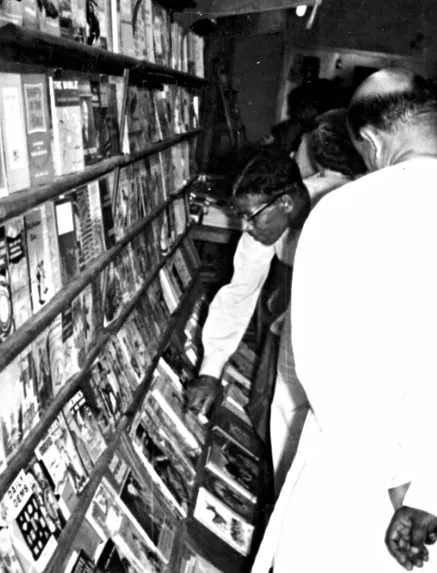
Photo: Mennonite Church USA Archives, No restrictions, via Wikimedia Commons
Here's a thing that happens to a lot of readers: you open Goodreads, or scroll your BookTok feed, or click through Amazon's "Customers Also Bought" rabbit hole, and ninety minutes later you've added fourteen books to your TBR list — none of which you actually want to read. You've been optimized. Curated. Personalized into paralysis.
Some readers have decided they've had enough of it.
The Recommendation Industrial Complex
We live in the golden age of book discovery, technically speaking. There are more ways to find your next read than at any point in human history. Algorithms trained on your reading history. Newsletters targeting your exact demographic. Influencers who've built entire careers on knowing what kind of reader you are and what you should pick up next.
And yet a lot of readers report feeling less excited about books than they used to be. There's a flatness to the experience of reading something you were statistically predicted to enjoy. It arrives pre-validated. The surprise is gone before you even crack the spine.
This is the paradox of algorithmic recommendation: the better it knows you, the less room there is for you to discover something about yourself.
What Algorithm-Free Reading Actually Looks Like
The readers who've opted out of the recommendation machine aren't doing anything dramatic. They're just doing what readers did for most of human history: wandering into bookstores and picking things up. Browsing library shelves without a destination. Following a title that catches their eye for no reason they can articulate.
Some have rules. One reader in Austin made a personal commitment to spend one month a year buying only books whose covers she found interesting, with no prior knowledge of the author or reviews. Another in Chicago walks into his local branch library, closes his eyes, picks a section, and takes the third book on the second shelf. Yes, really. He's read a biography of a 19th-century botanist, a translated Vietnamese novel, and a self-published memoir about competitive dog grooming. He says it's the best reading year he's ever had.
The practice goes by a few names in online reading communities — "blind buying," "shelf roulette," "reading without a net." Whatever you call it, the common thread is the deliberate rejection of outside input in favor of raw, unmediated instinct.
What You Actually Miss When the Algorithm Decides
Here's what a recommendation engine can't give you: the experience of picking up a book for a reason you can't explain and having it be exactly what you needed. That kind of serendipity isn't inefficiency. It's the whole point.
Algorithms are very good at predicting what you'll like based on what you've already liked. They are structurally incapable of introducing you to something that doesn't fit your existing pattern — because patterns are all they see. If you've spent five years reading contemporary literary fiction, the machine will keep serving you contemporary literary fiction until you die. It doesn't know that you might be secretly ready for dense Victorian history, or absurdist science fiction, or a slim collection of poetry that rewires your brain.
That expansion only happens when you step outside the feedback loop.
There's also a cultural argument here. Recommendation algorithms don't just reflect reading trends — they create them. When millions of readers are all getting nudged toward the same twenty titles, those titles become massive and everything else shrinks. The mid-list author, the regional press, the translated work from a language the algorithm doesn't weight heavily — these get starved of oxygen not because readers wouldn't love them, but because they never appear in the queue.
The Indie Bookstore as Antidote
This is part of why independent bookstores matter so much to algorithm-free readers. A good indie isn't just a place to buy books — it's a curation made by a human being with actual taste and actual blind spots and actual enthusiasms that don't always make commercial sense.
The staff recommendation card on a shelf at your local independent is the work of someone who read that book and felt something and wanted to tell you about it. That's categorically different from a system that noticed you bought three thrillers in a row and generated a list. One is a conversation. The other is a prediction.
When you walk into a bookstore without a list and just start touching things, you're trusting yourself in a way that digital browsing rarely asks you to. You're using your eyes and your hands and some deep, pre-verbal instinct about what you need right now. That's not nostalgia. That's agency.
How to Start Reading Without a Net
If you want to try it, you don't need to delete your apps or burn your TBR list. Start small.
Try the one-random-book rule. Every time you finish a book, let your next one be something you find by physically browsing — no reviews, no ratings, no plot summaries beyond the back cover copy. Just the book in your hands and your gut reaction to it.
Give yourself permission to be surprised. The book you pull off the shelf on a whim might not be what you'd have chosen rationally. That's the whole point. Read it anyway, at least for fifty pages, and see what happens.
Notice what the algorithm has been steering you away from. If you've never read Westerns, or graphic novels, or books translated from Korean, ask yourself whether that's actually your preference or just a groove you've been nudged into.
Trust the weird pull. You know the feeling — a spine catches your eye, a title makes you tilt your head, something about the weight of a book in your hand feels right. That instinct is real. It knows things the algorithm doesn't.
Taking hold of your own reading life means exactly that — taking hold. Not handing the controls to a system that's optimizing for engagement rather than growth, surprise, or the kind of book that quietly changes you over the course of a year. The algorithm is good at giving you more of the same. Only you can give yourself something genuinely new.