Grown-Ups Get a Story Before Bed Again — Only Now There's a Microphone and a Bar Tab
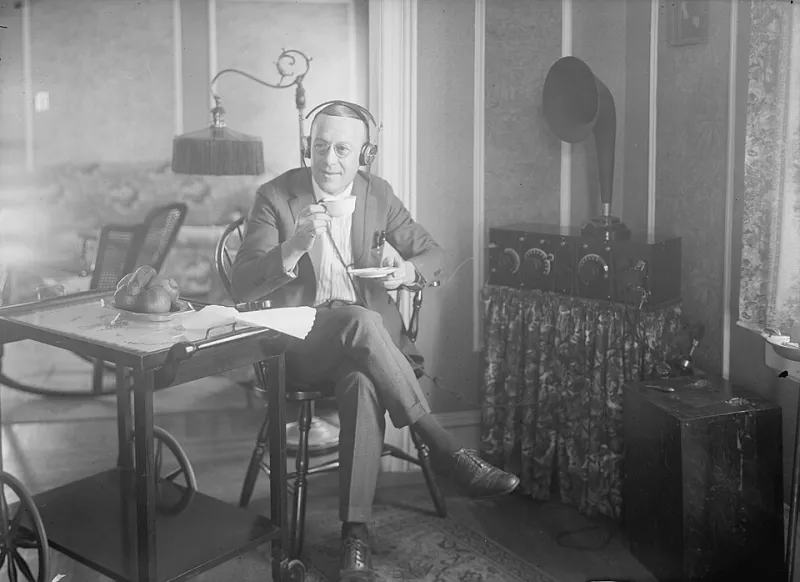
Photo: Uncredited photographer for Bain News Service., Public domain, via Wikimedia Commons
It's a Wednesday night in a bar that normally hosts trivia, and about forty adults are doing the thing you're not supposed to do in a bar: listening.
Someone has been handed a microphone and a paperback. She's reading a passage about a flooded kitchen — four paragraphs, nothing dramatic — and the room has gone quiet in that particular way rooms go quiet when nobody feels obliged to fill the silence. Somebody's beer sweats onto a coaster. Somebody laughs a half-second after everyone else, because the joke was in the pause before the last line.
When she finishes, there's the awkward beat that follows all live reading, and then the applause, which is louder than it needs to be. The next name gets called. The night rolls on.
How We Got Here
If you'd predicted a decade ago that adults would voluntarily sit in public and be read to, you'd have been laughed out of the room. Then a few things happened in sequence.
Silent Book Club started in San Francisco back in 2012 with a simple idea — show up, order a drink, read your own book alongside other people who are also reading their own books, talk about it afterward if you feel like it. It spread to hundreds of chapters because it solved a real problem: reading is a solitary pleasure that a lot of people wanted to do near other humans. Then, in the early 2020s, the reading-party phenomenon took hold in New York, with events that treated literature as a social occasion complete with curated passages, timed reading blocks, and a lot of eye contact. The scaffolding has been in place ever since.
What's different in 2026 is the microphone. Silent reading nights ask you to bring your own book and keep it to yourself. Read-aloud nights ask you to hand your attention to someone else.
Why Listening Is the Exercise
Ask the hosts and you'll get a consistent answer: this isn't really about storytelling. It's about attention.
We have spent the last several years training ourselves to half-do everything. Read a page, check a phone, read the page again. Listen to a podcast at 1.5 speed while answering email. Even reading for pleasure has acquired a nervous, scanning quality — the eye skimming ahead, the brain already drafting the group-chat message about the thing it's about to finish.
Being read to removes the option. You cannot skim a voice. You have to sit in the tempo of another person's breath, and if the reader is good, you find out that a sentence takes about as long as it takes. It's a strange relief.
There's a wellness angle that organizers are leery of overselling but nobody denies. People come in wound up and leave slower. A room full of adults holding still for twenty minutes is, in 2026, a genuinely unusual sight.
The Bookshop Edition
Indie stores have been the most enthusiastic adopters, for obvious reasons. A read-aloud night sells a few copies, sure, but the bigger win is that it turns a retail space into a place where people stay for two hours. Stores that used to clear out after a Thursday author event now run monthly series where the lineup is just local readers with a favorite passage — one poem, one page of a novel, one paragraph of nonfiction, five minutes max.
The five-minute cap matters. Too long and the room drifts. Too short and it feels like a joke. The sweet spot, per organizers, sits somewhere between three and seven minutes, and the material has to work out loud — which rules out an enormous amount of perfectly good prose.
The Library Meeting Room, Where It's Free
Public libraries have taken the idea and done what libraries do: made it free, made it accessible, and made it happen on a Tuesday at 6:30 when the buses still run.
Some branches pair the reading with a theme — letters, first jobs, weather, whatever the staff is excited about. Some run bilingual nights. Some let whoever shows up read whatever they want, which produces the wonderfully chaotic lineup of a death scene from a thriller followed by a recipe from a grandmother's notebook. The library version has a distinct advantage over the bar version: nobody's competing with a jukebox, and the chairs are better for your back.
What Makes a Good One
The hosts who've been doing this a while have converged on a few unspoken rules.
- Read the page, don't perform the page. The reader who does voices wears out the room in four minutes. The reader who just reads, with a little care, holds it all night.
- Don't apologize before you start. Nobody needs to hear that you're nervous. Start.
- Pick something you love without explaining why. The explanation is what makes it awkward.
- No phones on the table. Not because phones are evil, but because the whole point is the twenty minutes where nobody's checking.
Not Nostalgia, a Correction
It would be easy to sell adult story hour as childhood revisited — milk and cookies, warm fuzzies, the return of the classroom rug. That's not what's happening in these rooms.
What's happening is a correction. Reading got very private and very optimized: personal library apps, algorithmically perfect recommendations, bookmark tracking, yearly totals posted to social feeds. All of it measurable, none of it shared in real time with another human being.
A read-aloud night offers the opposite. It's unmeasurable. You can't log it. You can't screenshot it. You just sit there with forty strangers and one voice and let a kitchen flood in somebody else's book, and then you go home slightly better than you came in.
That's not a gimmick. That's a small piece of infrastructure for a life of reading.